Unleaded is a reality thriller alongside a comedic undertone, from the director Luke Davies and the theme of drugs, crime and working class people. When three thugs attempt to rob a petrol station they’re unfortunately interrupted by the most unlikely of heroes; three men on drugs, who are on the phone and want food.
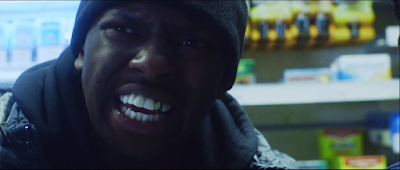
Camerawork creates contrast between the two groups that have pulled up at the petrol station and the mood that is created because of it. The woman in the car on her own is portrayed using much closer shots as compared to the two men in the car. This emphasises her contemplation and worry as she waits for the other two antagonists to finish thieving the shop and to leave. The two men in the car are often seen in a two shot, which requires a wider shot to fit them into. This helps to exaggerate their body language and the fact that they are under the influence of drugs. This creates a lighter mood compared to the female in the neighbouring car, especially as one shot shows her face through the interior mirror, which may emphasise how aware she has to be to stay out of trouble, which conflicts with the two males laid back appearance and mood. Furthermore, the influence of drugs and lack of awareness is shown through the male protagonist’s close up in the shop, in which the main thug holding a gun is depicted in the shallow focus in the background. This highlights his lack of awareness and supports the issue of drug use.

The non-diegetic sound creates verisimilitude, which allows the audience to see the issues and themes surrounding poverty and low economic status, specifically the dialogue. The scene inside the shops allows audiences to hear the vulgar language and tone of voice used, which may be associated with working class social groups. Whilst the protagonist uses this language and angry manner too, as it creates an arguably more effective opposition between him and the thugs, the companions that he drove to the petrol station with take on a contrasting tone of voice. When cutting from a scene in their car to a scene in the shop, the pair in the car seem very relaxed and somewhat spaced out compared to the angry men in the shop. Levi Strauss’ ‘binary opposition’ theory may be applied here, as their accents also appear to be different to those trying to rob the shop, which might create an opposition between regionalities. This is supported by the fact that their friend, who speaks in similar tone to the thugs, also argues with them whilst he’s in the shop.
Parallel editing has been used to create comedic effect in this short, which also helps the audience to better understand the narrative. This suggests to the audience that the switch to and from the two scenes is creating meaning by implying they are connected and that the drug addicts will meet the thugs as the narrative of the film progresses. This links the characters together, and being in the same place may emphasise the result of them both practicing illegal activity. This therefore, supports the issue of crime.
Furthermore, the editing style may exaggerate the protagonist’s point of view within the short. Long takes justify the use of ellipsis in the narrative, to keep the audience from getting bored, as well as to mimic the effect that drugs have on the mind of the protagonist. Long takes might emphasise delayed reactions and lack of awareness in his surroundings, whilst ellipsis may make clear his inability to recall recent events or understanding of time. This ties in with the issue of drug abuse.
The binary opposition between low key and high key lighting may represent the confidence and independence that each of the characters have. Inside the shop is portrayed as having high key lighting, and as being visible to those outside in the dark. This is an exposed area and seems that only some are willing to enter it. This might exaggerate the confidence that these individuals bear to be able to walk inside. The dark area might represent the unknown and perhaps even foreshadows the shooting of the woman towards the end. This is because she spends most of the film hidden in the outside area of the petrol station, yet decides to walk in, perhaps based on what she sees from the car pulled up next to hers, which might not have been clear to her and led her to misunderstanding. The low key lighting outside therefore draws attention to the obscurity of the events happening inside. This supports the theme of misinterpretation.


Marilyn Milgrom’s The Script may be applied to Unleaded, as it has a world, a character, and a problem. The world for this short is the petrol station. The character is the protagonist who has entered the petrol station shop in search for food. His problem is that his friends are unsympathetic and force him into the petrol station to buy them food. Little does he know, he is also being held at gunpoint. Milgrom also states that one of three things must drive the character through the narrative; a want, a need, or an obligation. In this case, the man’s want to find something to eat is what drives the narrative forward. She also makes a point that it is important to make the end of the film meaningful by choosing the best point of view to tell the story from. This short film portrays the protagonist as the best point of view, as he creates the comedic effect through the way that he talks to his friends and supposedly the thug, and his lack of awareness of the whole event.


